

 Arabic
 Spain
Spain Germany
 France
 Japan
Japan Portuguese
 Russian
 Chinese
 Thailand
 Vietnam
 Indonesia
 India
IndiaNews
THE PIONEER IN FACADE SOLUTIONS


Yes, several major ACP manufacturers make both fire-resistant (FR) and standard (PE) panels. You can find these choices from top brands like ALPOLIC, Alucobond, Reynobond, and WILLSTRONG®.
Yes, several major ACP manufacturers make both fire-resistant (FR) and standard (PE) panels. You can find these choices from top brands like ALPOLIC, Alucobond, Reynobond, and WILLSTRONG®. This fixes a common issue.
You often need one supplier for projects with different needs. For example, a building might have a regular outside but fire-safe inside areas. Using one maker makes shipping, costs, and quality checks easier. This article looks at these leading brands. It compares their FR and standard options for an Aluminum Composite Panel (ACP) . You will also get useful tips on picking the best choice for your needs.
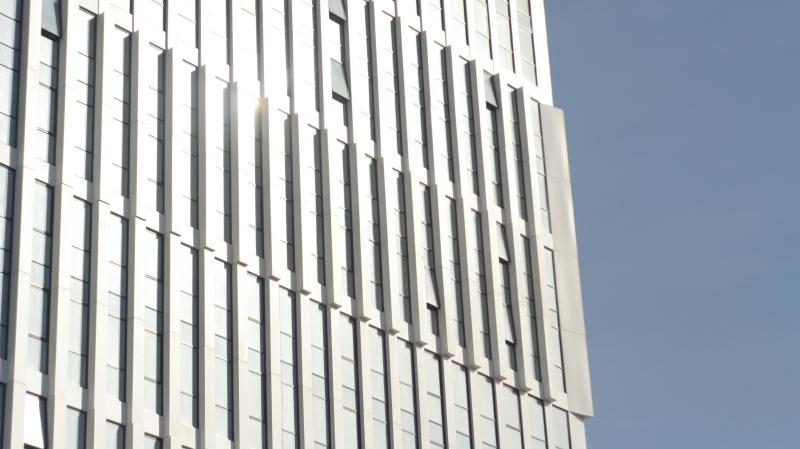
Top brands such as ALPOLIC, Alucobond, Reynobond, and WILLSTRONG offer both fire-resistant and standard panels.
Fire-resistant panels have a mineral core that does not catch fire, while standard panels have a polyethylene core that catches fire easily.
Always check that the panel meets local fire codes like ASTM E84 or NFPA 285 before you buy.
Buying both panel types from one supplier simplifies ordering, shipping, and quality control.
Several well-known brands lead the global market for aluminum composite panels. Each offers both standard polyethylene (PE) core panels and fire-resistant (FR) versions.
Several well-known brands lead the global market for aluminum composite panels. These ACP makers have earned strong reputations over many years. They supply projects around the world with steady quality. Each offers both standard polyethylene (PE) core panels and fire-resistant (FR) versions. Having both options makes your buying process much easier.
Having standard and fire-resistant options available from the same manufacturer can simplify procurement, logistics, quality checks, and project coordination.
ALPOLIC, part of Mitsubishi Chemical, is a top player in this field. The company reported US$1.05 billion in yearly sales from its ACP business in 2024. ALPOLIC makes two separate product lines. The ALPOLIC/PE series uses a thermoplastic polyethylene core for everyday uses. The ALPOLIC/fr series has a mineral-filled thermoplastic core. This FR line holds an IBC listing for fire safety rules. You can pick either option based on your project's code needs.
Alucobond, another major name, offers similar choices. The standard Alucobond panel works for typical facades and indoor uses. The ALUCOBOND PLUS version includes a fire-retardant mineral core. This product meets strict building rules in many regions. Architects trust Alucobond for its steady finish quality and dependable performance.
Reynobond finishes the group of global leaders. The standard Reynobond panel gives cost-effective cladding solutions. The REYNOBOND FR version adds mineral flame retardants to the polyethylene core. This change boosts fire performance without losing formability. You get design freedom while staying safe and compliant.
| Brand | Fire-resistant panel | Standard panel |
|---|---|---|
| ALPOLIC | ALPOLIC/fr (mineral-filled thermoplastic core) | ALPOLIC/PE (polyethylene core) |
| Alucobond | ALUCOBOND PLUS (fire-retardant mineral core) | Standard Alucobond |
| Reynobond | REYNOBOND FR (polyethylene core with mineral flame retardant) | Standard Reynobond |
These three brands lead commercial projects. Their distribution networks reach across the globe. Lead times stay predictable for most areas. However, you might want more options. Newer makers now challenge these leaders with fresh features.
WILLSTRONG® enters this competitive market with a strong value offer. This ACP maker provides both standard and fire-resistant panels. You get the ease of buying from one source. The product line features advanced surface technologies.
The WILLSTRONG® ACP offers antibacterial and antistatic properties. These features support cleaner, safer indoor spaces.
As industry experts note, "Fire-resistant and antibacterial properties are becoming standard for hotel projects."
WILLSTRONG® stays ahead of this trend with its complete approach.
WILLSTRONG® positions itself as a partner for complex needs. The company focuses on tailored solutions rather than ready-made products.
WILLSTRONG® offers both panel types with advanced features. This mix simplifies your supply chain. You keep quality control across your whole project. The result is a smooth process from specification to installation.
Core materials, fire performance, certifications, pricing, availability, applications, and lifespan all affect the choice between standard and fire-resistant ACP.
The main difference between standard and fire-resistant ACP panels is what is inside their core. Standard panels have a polyethylene (PE) core. This core is made of up to 100% thermoplastic polymer. This material burns easily. When heat is applied, the PE core melts and catches fire. It helps the fire spread across the building. The core also expands when it gets hot, which causes it to change shape.
Fire-resistant panels use mineral fillers that do not burn. They replace most of the polyethylene with these fillers. A typical FR core has about 70% aluminum trihydroxide or magnesium hydroxide and 30% polymer binder. The mineral content makes it hard for the panel to catch fire. It also burns less strongly. The FR core stays more stable when it gets hot. It also produces much less smoke during a fire.
| Property | Standard (PE) ACP | FR ACP |
|---|---|---|
| Core composition | Up to 100% polyethylene | ~30% polymer, ~70% mineral filler |
| Euroclass rating | B to E (combustible) | B-s1,d0 (limited combustibility) |
| Smoke generation (s) | s1 to s3 | s1 (low smoke) |
| Flaming droplets (d) | d0 to d2 | d0 (no droplets) |
| Typical application | Interior signage, low-rise | Mid-rise facades |
| Relative cost | Lowest | Mid |
Safety certifications tell these products apart in regulations. The NFPA 285 standard tests the whole wall assembly in a real fire situation. To pass, the flame must not spread more than 10 feet above the window opening. It must not spread more than 5 feet to the side from the window center. The temperature must stay below 1000°F at a point 10 feet above the opening. The second-story room cannot see a temperature rise of more than 500°F above the starting level. Flames cannot reach the inside of that room.
Standard PE cores do not pass NFPA 285 for tall buildings. FR cores can pass when tested as part of a correct assembly. Mineral-filled cores pass in the most types of setups. Other certifications are UL 723 or ASTM E84 for surface flame spread and smoke. European projects use the A2-s1,d0 rating under EN 13501-1. Australia uses AS 1530.1 for combustibility testing. You must check that your panel has the right certification for your area and building type.
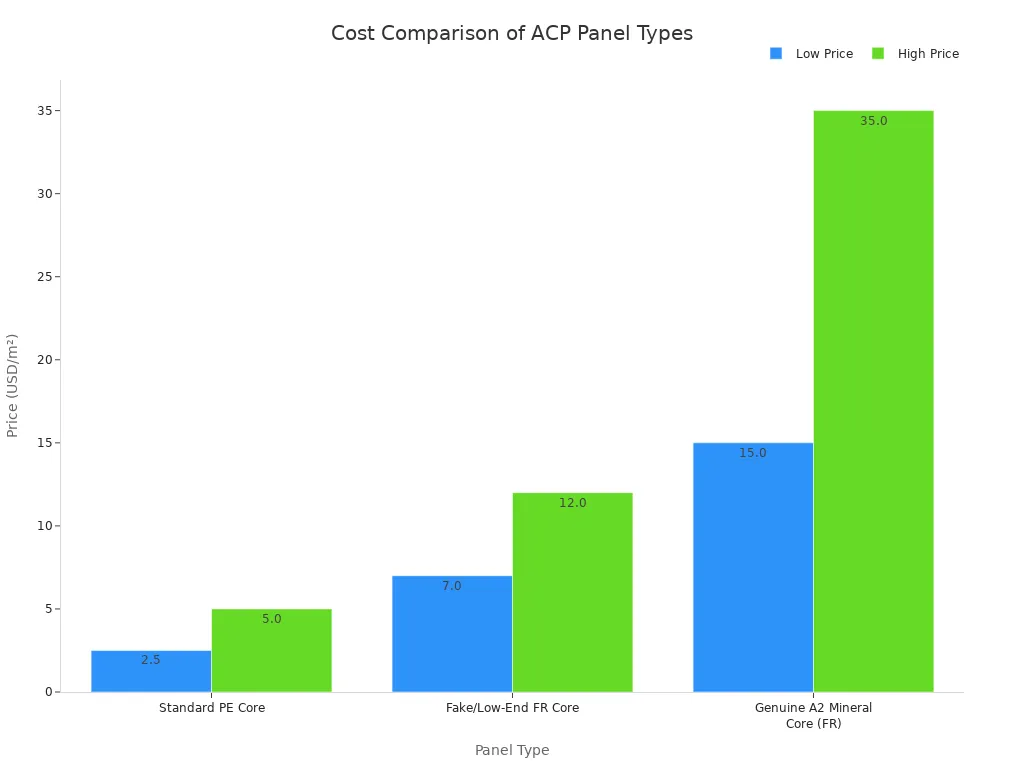
The cost difference comes from the core materials. Standard PE panels usually cost between $2.50 and $5.00 per square meter. Real A2 mineral core FR panels cost between $15.00 and $35.00 per square meter. The price gap is between $10.00 and $30.00 per square meter. Some sellers offer cheap FR products at $7.00 to $12.00 per square meter. These panels often use unverified core materials and do not have proper certification.
What you choose depends on where you use it. Standard PE panels work well for low-rise homes, inside walls, false ceilings, and signs. These uses have lower fire risk and less strict rules. FR panels are good for mid-rise and high-rise buildings, commercial buildings, and outside walls in crowded cities. The mineral core gives better heat and shape stability for these tough environments.
Standard PE panels last 15 to 20 years with good corrosion resistance. FR panels last 20 to 30 years or more. High-quality PVDF coatings can make FR panels last even longer than 30 years.
ACP panels can last 15 to 30 years in wet places if you pick good ones and take care of them. Their smooth surface and special coatings like PVDF or FEVE help stop water, rust, and fading. Always choose panels with thick aluminum layers and fire-retardant cores for better strength in wet weather.
You get a big advantage when you buy both panel types from one seller. One buying plan makes shipping, price talks, and quality control easier. You keep the same finish quality across your whole project. You also make warranty and tech support simpler. Top ACP makers, like WILLSTRONG®, offer both standard and FR options. This choice lets you pick the right panel for each part of the building without dealing with many sellers.
The right manufacturer should meet project compliance requirements while also providing technical support, customization, quality control, and reliable delivery.
Start by looking at your building's height and how many people use it. Tall buildings need fire safety, wind resistance, durability, and a plan for upkeep over time. You need panel systems that pass wind-load tests. You also need FR and A2 core production capability. Ask yourself: What local fire codes apply? What is your budget? These answers tell you if you need FR panels everywhere or only in certain areas.
Local fire codes play a big role in your panel choice. The table below shows how different factors affect your selection.
Building height, occupancy, location, core type, and local authority requirements all influence the final ACP selection.
| Factor | How local fire codes affect ACP panel selection |
|---|---|
| Core type | Codes require specific core (PE, FR, A2) based on building height and use. PE core may be banned in high-risk zones. |
| Fire standard | Codes reference different standards (e.g., EN 13501, ASTM). Panels must have a report matching the local standard. |
| Building use | Stricter codes apply to hospitals, schools, towers, etc. Some building types may prohibit composite panels entirely. |
| Full assembly | Codes often require a full wall assembly test (including insulation, cavity, fixings) rather than just the panel alone. |
| Local authority | Local authorities have the final say; rules vary by city and project. Approval from local consultant is required. |
How the building is used matters just as much. Public places need fire-retardant sheets. Mineral-rich cores provide fire resistance, allowing extra time for evacuation. As industry experts note, "Fire-resistant and antibacterial properties are becoming standard for hotel projects."
A strong ACP manufacturer provides OEM/ODM customization for size and thickness. They offer technical support for façade system design.
They keep consistent batch quality control for large-scale projects and support consistent product performance across project requirements.
Lead times affect your schedule. Custom lengths and reliable production planning can reduce installation complications and support project timelines.
Look beyond the product itself. Check technical support, warranty terms, and lead times. A strong ACP manufacturer provides OEM/ODM customization for size and thickness. They keep consistent batch quality control for large-scale projects. They offer technical support for façade system design.
Warranty terms vary widely. They typically cover color fading, chalking, and delamination. Guarantees often use pro-rated terms. A typical PVDF warranty covers fading beyond a certain Delta-E value over a specified period.
Lead times affect your schedule. WILLSTRONG offers custom lengths, reducing horizontal joints on tall facades. Fewer joints mean faster installation and cleaner aesthetics. Always verify that the manufacturer's FR certification applies to your specific region. Not all fire-resistant ratings are equal. Confirm the certification matches your local standard. This verification protects your project from costly delays.
Top ACP makers sell both fire-safe and regular panels. This makes your supply chain simple. You can buy from one company, such as ALPOLIC, Alucobond, Reynobond, or WILLSTRONG. Always check certifications like ASTM E84 or NFPA 285 with the maker. Not all fire-safe ratings are the same. Make sure your chosen panel meets your local code. Do not just look at the product. Check the company's help, on-time delivery, and skill. WILLSTRONG offers custom lengths and antibacterial and antistatic properties. These help projects with unique size or performance needs. Pick a trusted partner that makes your project succeed from start to end.
Practical questions about certifications, mixed panel use, custom-length FR panels, installation, and project requirements.
Ask the maker for the test report. Make sure the certificate matches your local building code, like ASTM E84 or NFPA 285 . Check that the report covers your panel thickness and core material. Ask for a sample to test yourself if your project needs it.
Yes, you can. Many projects use standard panels for low-risk spots like indoor walls and FR panels for outside walls or tall parts. Buying both from one maker, like WILLSTRONG® or ALPOLIC , makes ordering easier. Make sure your local fire code allows this mix for your building type.
Delivery time depends on the maker and order size. Standard lengths ship in a few weeks. Custom lengths may take longer. Always confirm the time before you order. Add shipping time for international orders. Ask your supplier for a written delivery schedule.
FR panels use the same basic install methods as standard panels. But you must use fire-rated sealants and gaskets at joints. The mineral core is heavier, so you may need more support brackets. Always follow the maker's install guide. Make sure your crew has experience with FR panel systems.
First check your local building code. Buildings over a certain height, often set by local code, may need FR panels. High-use buildings like hotels also need them. For low-rise homes or indoor decoration, standard panels are often fine. Ask your architect or a fire safety engineer for the final answer.
Top ACP makers offer both fire-safe and regular panels. The right choice depends on local code, building type, core material, certification, application, technical support, lead time, and long-term performance.
 Leave a Message