
 Arabic
 Spain
 Germany
 France
 Japan
 Portuguese
 Russian
 Chinese
 Thailand
 Vietnam
 Indonesia
 India
News
The pioneer in facade solutions


The panel isn't the problem. The supply scope is. On large formats, failures come from gaps between what a supplier tests, bonds, makes, and ships — not from the panel itself.
The honeycomb panel manufacturers best suited to large-format facade work share four traits. They document fire and emissions performance. They prove their bonding technology. They make oversized formats in-house. They have supply scale for full envelopes. That mix, not a catalog photo, defines the shortlist.
Readers will finish this section able to build a shortlist, ask for the right documents, and tell aluminum honeycomb panel suppliers apart from material specialists. Each step lowers risk before the first quote arrives.
A reliable supplier is qualified by the complete manufacturing and delivery scope, not by the appearance of a sample panel
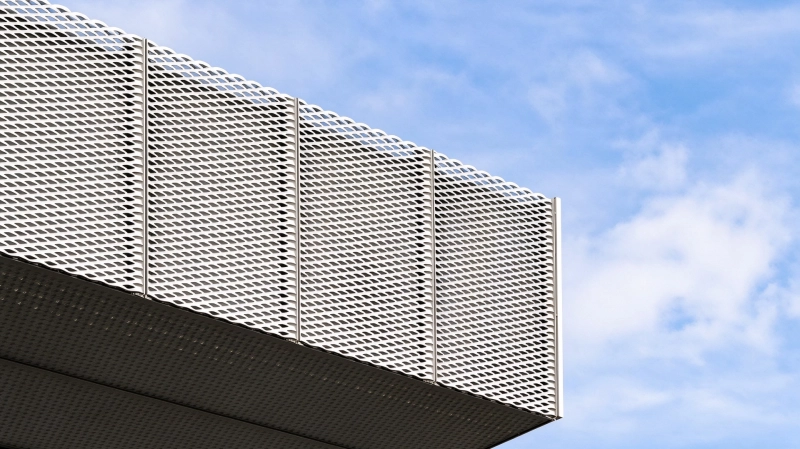
Five practical checks help buyers evaluate manufacturers before requesting quotations.
Look at the fire and emissions reports for the exact panel build you will get.
Ask for bond strength test data to make sure the skin stays attached under wind load.
Make sure the supplier can make your largest panel size in their own factory without splitting it.
Pick one supplier who handles everything so you have a single point of contact for the entire facade.
Specify Rw + Ctr for acoustic performance near roads or rail, so you account for low-frequency noise.
Large-format panels change handling, flatness control, wind-load distribution, and the way manufacturers must manage production.
Large format starts at about 1.5 m wide or 4 m long. Past that line, the panel stops acting like a cladding sheet and starts acting like a structural element. Handling changes first. Two installers can no longer lift and place a unit by hand. Vacuum lifters, custom crates, and wider transport frames enter the plan.
Flatness becomes a visible specification. A small wave across a narrow panel disappears at a distance. The same wave across a four-meter span shows up as a shadow line under grazing sunlight. Chenshou Tech publishes flatness tolerances of plus or minus 0.5 mm per 1000 mm of span, with surface flatness held within 1 mm. Suppliers must hold that tolerance across the full sheet, not just a sample.
Wind load and joint design follow. Larger panels collect more pressure and pass it through fewer joints. Each joint must absorb more movement. The qualification criteria shift from catalog appearance to engineering capability.
Flatness, bonding consistency, structural interfaces, and installation handling must all be considered together. A supplier's actual engineering capability becomes more important as panel dimensions increase.
At scale, three engineering factors decide performance: flatness tolerance, core-to-skin bond uniformity, and the substructure interface. The panel catalog rarely predicts any of them.
Bond uniformity matters most. Carbosources lists skin-to-core debonding among the common failure modes of sandwich panels. Poor surface preparation, inadequate adhesive coverage, peel stress, and moisture can all start a disbond. A published study in PMC notes that fabrication and assembly defects commonly appear as skin-core debonding and core or skin cracks. Other modes include face wrinkling, intracell buckling, global buckling, and core shear failure.
The substructure interface carries these loads into the building. A weak connection concentrates stress at the panel edge. The material choice itself supports the structure: aluminum honeycomb panels deliver stiffness, low weight and dimensional stability in one assembly. That combination lets an aluminum honeycomb panel span further with less steel behind it. The facade then depends on the supplier's bonding control and interface detailing, not on the panel name.
Four criteria separate a qualified supplier from a catalog listing. Each one gives a buyer a document or a skill to check before making a shortlist.
Fire performance starts with a classification report, not a claim on a data sheet. A supplier should show a test report from a recognized lab, a classification document that names the product family, and emissions data for the full assembly. The report must match the panel build the project will receive. A certificate for a different core or adhesive proves nothing. When a supplier claims A2 classification under the European fire standard EN 13501-1, the report should name that standard and the tested build.
Emissions documentation covers volatile organic compounds and formaldehyde where the project requires it. Buyers should check that the test sample matches the specified thickness and finish. Gaps here usually show up as expired reports or reports for a narrower format than the one quoted.
Core type, adhesive, thickness, surface finish, and mounting arrangement all influence whether a test document applies to the delivered product.
Bond strength can be measured. ASTM C297/C297M-16, the standard test method for flatwise tensile strength of sandwich constructions, checks core-to-facing bond quality and load transfer between facings and core, per ASTM. Peel tests add another view: ASTM D1781 covers the climbing drum peel test for sandwich panels, while ASTM D3167 and ASTM D1876 cover floating roller and T-peel methods, as Puglue describes. A supplier who cannot produce flatwise tensile and peel data has not qualified its bond. For an aluminum honeycomb panel, that bond decides whether the skin stays attached under wind load.
Press capability sets the real format limit. The press platen size, core expansion capacity, and finishing line decide the largest sheet a supplier can hold to tolerance. A platen that cannot cover the full sheet forces the supplier into secondary processes, and flatness suffers. In-house fabrication scope follows: edge closure, returns, and cutouts done under the same roof remove a handoff. Supply scale for full envelopes closes the framework. Buyers comparing aluminum honeycomb panels should ask for the full-envelope delivery plan across the facade, not a sample run.
Check product-specific fire classification, laboratory test reports, emissions results, and the validity of supporting certificates.
Review flatwise tensile and peel test results, press capability, edge processing, and the supplier's actual in-house manufacturing scope.
Production dimensions, prefabrication, packaging, and transportation determine whether oversized panels can reach the site in installation-ready condition.
Press size sets the top limit on format. A platen has to cover the whole sheet, or the supplier splits the panel and flatness drops at the seam. Core expansion works the same way. The honeycomb core spreads across the full panel area before bonding, so the expansion line must match the press. Finishing lines for coating, anodizing, and laminating must handle the same length. If not, the sheet moves between plants and picks up handling risk. An aluminum honeycomb panel wider than the platen needs a second process, and tolerance slips.
Published limits show the range. Kerr Panel says it builds panels as large as 12' x 36'. LMC Metal lists aluminum-faced honeycomb panels at up to 2000 mm wide and 8000 mm long, with stainless steel-faced panels at standard widths of 1000, 1219, or 1500 mm and lengths up to 8000 mm.
Compare each supplier's maximum production dimensions against the largest finished facade panel in the project schedule.
| Panel Type | Maximum Width | Maximum Length |
|---|---|---|
| Stainless steel-faced honeycomb panels | Standard widths 1000 / 1219 / 1500 mm | ≤ 8000 mm |
| Aluminum-faced honeycomb panels | ≤ 2000 mm | ≤ 8000 mm |
Buyers should compare these limits against the largest finished facade panel in the schedule, not the typical one.
Oversized panels need prefabrication before they leave the plant. Edge closure, return features, and cutouts done in-house remove a field handoff. Packaging then carries the load. Honeycomb crating suits fragile, heavy, or oversized items, and OEM Materials notes that honeycomb crates are usually lighter than similar wood constructions. Bracing limits internal movement, and cushioning manages impact. Corner guards protect the points most exposed to concentrated force, as ShipDuo advises. Pallet footprints should match the product base with no overhang.
Transport limits close the loop. Long units bend when lifted from one side, so internal bracing must address bending first. Smurfit Kappa notes that hexacomb packaging needs no export certification, which simplifies cross-border delivery of aluminum honeycomb panels. A supplier who plans crating, orientation marks, and lifting points alongside the facade schedule has qualified its delivery scope.
Complete edge closures, returns, and cutouts before shipment to reduce site processing and production handoffs.
Use suitable crating, internal bracing, cushioning, and corner protection to control movement and impact.
Coordinate lifting points, orientation marks, pallet footprints, and transport dimensions with the facade schedule.
The shortlist is split by role, not by rank. Some suppliers handle the whole envelope scope. Others engineer the core and the panel build with unusual depth.
Buyers should compare honeycomb panel manufacturers inside their own group first.
Full-scope suppliers carry the panel from raw material to the finished facade panel. They bond, coat, fabricate, and crate under one roof. That scope removes handoffs, and handoffs are where flatness and bond quality usually slip.
HyCOMB, Huarui, and Alstone each run a facade-oriented product portfolio that covers cladding, ceilings, and interior work. They suit projects that need one supplier accountable for the full envelope. Buyers should still request fire reports for the exact build quoted.
Pacific Panels calls itself an aluminum honeycomb panel manufacturer, per the Beacon Journal press release. Its value to the shortlist is a US-based manufacturing identity for buyers weighing domestic against imported supply. The same release includes no panel-specific fire test or capacity figure for the company. Treat Pacific Panels as a supplier to qualify, not a pre-verified compliance source.
Sinoextrud calls itself a professional manufacturer of aluminum honeycomb panels for architectural and industrial use. The company states it offers custom fabrication, including CNC cutting, bonding, and surface treatment. That flexibility fits project-specific sizes and finishes. Fire and emissions documents should be requested for the exact product and coating system.
Nanbeiwang brings the broadest documented certificate set in this group. The Beacon Journal release records the following profile.
| Attribute | Nanbeiwang |
|---|---|
| Founded | 2013 |
| Location | Foshan |
| Facility size | 80,000 m² |
| Annual output | 1,000,000 sheets |
| Export share | 50% of sales |
| Panel thickness | 5–18 mm |
| Standard size | 1220×2750 mm |
| Fire rating | A2 |
| Formaldehyde | Zero formaldehyde under GB18584-2024 |
Its certificates cover ISO9001:2015, ISO14001:2015, SGS RoHS, hazardous substances, formaldehyde emission, and peel strength under JC/T 2113-2012. That breadth suits buyers who need a full document pack at tender stage.
Company profiles and published capabilities are starting points. Every candidate still needs to provide project-specific reports, production limits, and evidence that its quoted construction matches the required specification.
A honeycomb core and panel manufacturer of this type engineers the bond and machines the sheet. Plascore and Hexcel both work at the core-to-panel level. Their strength sits in core engineering and material science rather than in coating lines or sub-frame design. They fit projects where the design team specifies the core and needs a partner who understands bond behavior and panel mechanics.
Kerr Panel belongs in the same group for a different reason. It machines very large panels, and the previous section noted its published format capability. That makes it a fit for oversized units where cutting and finishing tolerance decide the outcome. Buyers choosing this group should confirm who owns edge closure, coating, and the installation interface. Those tasks often sit outside a specialist's scope.
The split is practical. Full-scope suppliers suit single-point accountability across a whole facade. Specialists suit teams that keep design control and need deep panel engineering. Neither group is better in the abstract. The project profile decides.

Fire classification must be assessed against the exact panel construction, rather than relying on a general product-family claim.
A2 is a rating under EN 13501-1, the European standard for how construction products react to fire. In simple terms, A2 means a material has limited combustibility, not that it is fully non-combustible. It ranks one step below A1 and far above the combustible classes. For a facade, that gap matters for non-combustible facade compliance on tall buildings and on projects with strict fire-safety rules.
A classification document is not the same as a test report. The test report shows what a lab did to a sample. The classification document names the product family, the thickness range, and the build that earned the rating. Buyers of fireproof aluminum honeycomb panel manufacturers should read both. The report must name the test standard used, the tested build, and the lab. The classification must cover the exact panel construction quoted, including core type, adhesive, and finish.
A2 performance also depends on the whole assembly. An all-aluminum honeycomb panels build with a mineral core and a thin skin acts differently from a thick-skinned panel with a different adhesive. A panel-level fire classification applies only to the tested build. A project-specific fire report should confirm that the delivered panel matches that build.
A2 indicates limited contribution to fire under EN 13501-1. Buyers must check the classification document and the tested product construction before applying the rating to a project.
Emissions data covers volatile organic compounds and formaldehyde. The test sample must match the specified thickness and coating. A report for a bare panel says little about a finished facade panel with a coated surface.
Suppliers often fall short in four places. Reports expire. Certificates name a different core or adhesive. The tested format is narrower than the quoted format. Emissions data covers the raw panel but not the coated product. Each gap leaves the buyer holding a claim without panel-level evidence.
Verification follows a simple path. Ask for the panel-specific fire certificate and the project-specific classification before shortlisting. Cross-check the tested build against the bill of materials. Confirm the report date and the lab accreditation. Request declared fire performance in writing for the exact cladding package. A supplier who cannot close these gaps has not qualified its fire performance, whatever the brochure states.
Panel manufacturers and core specialists perform different roles in the supply chain. Understanding the distinction helps buyers compare equivalent services.
The market puts two different kinds of supplier under one label. A material specialist makes the core or the bonded sheet. A full-scope fabricator turns that sheet into a finished facade panel. Buyers who compare them on price alone are comparing unlike things.
The Beacon Journal press release makes this line clear. CHALCO, Hexcel, Plascore, Euro-Composites, The Gill Corporation, and Alcore are stronger references for honeycomb materials or core technology. Nanbeiwang, Pacific Panels, and Sinoextrud present themselves as panel suppliers. A core supplier's data sheet does not certify a finished facade panel. A panel supplier's brand name does not replace a project-specific fire report.
| Company | Role | Offering |
|---|---|---|
| CHALCO | State-owned aluminum producer | Brazed aluminum honeycomb panel; metallurgical core-to-skin connection, an adhesive-free route |
| Hexcel | Advanced composites company | Aerospace-grade honeycomb cores in multiple cell sizes and densities; FAA and EASA-aligned certification |
| Plascore | Core and panel manufacturer | Raw cores and finished bonded panels; core-to-panel engineering for sandwich structures |
| Pacific Panels | Architectural and marine panel supplier | Ready-to-install panels meeting fire codes and wind load standards |
Specialists own the bond and the core. Plascore's advantage is core-to-panel engineering for sandwich structures, per the Beacon Journal release. That depth helps a design team compare cell size, skin bonding, and panel flatness before a facade package is fixed.
Hexcel brings process discipline from aerospace work. Strategic Market Research notes its tight vertical integration from aluminum foil production to final bonded panels. That control suits projects where repeatable bonding performance matters more than coating choice.
Full-scope fabricators own everything after the sheet: coating, edge closure, returns, crating, and the sub-frame interface. Pacific Panels, for example, supplies ready-to-install panels that meet fire codes and wind load standards, per Strategic Market Research. That scope suits a single-point facade contract.
The project profile decides the fit. Teams that keep design control and specify the core suit a specialist. Teams that want one accountable supplier for the whole envelope suit a full-scope fabricator. Buyers should compare honeycomb panel manufacturers inside their own group first, then weigh aluminum honeycomb panel manufacturers against core specialists only on the tasks each actually performs. All-aluminum honeycomb panels and aluminum honeycomb panels both reach the site through one of these two routes.
Focus on core engineering, material science, cell structure, and bonding performance. Suitable for project teams that retain design and fabrication control.
Coordinate coating, edge processing, returns, packaging, and installation interfaces. Suitable for projects that need a single accountable facade supplier.
Large-format facade design must consider sound transmission through the panel, joints, brackets, and surrounding substructure.
Sound insulation follows mass law: doubling surface density raises transmission loss by roughly 6 dB in the mass-controlled region. Aluminum honeycomb panels carry little mass for their stiffness, so the acoustic weak point sits at the coincidence dip, where the skin resonates and transmission loss drops sharply. The hexagonal core adds rigidity without adding much weight. Cavity fill and constrained-layer damping recover part of that loss. Microporous structures absorb mid- and high-frequency energy inside the cells, which improves absorption but does not replace mass. Frequency-divided insulation matters here: the skin governs low frequency, the core governs mid and high frequency.
Large format changes flanking paths. A four-meter panel has fewer joints, yet each joint and each substructure bracket becomes a stronger acoustic bridge. Sound travels around the panel through the mullion and the anchor, not through the sheet. Designers should treat the facade as one system, not a panel.
Joints, mullions, anchors, and supporting structures can create flanking transmission paths. Acoustic assessment should therefore consider the complete facade assembly.
Rw is the weighted sound reduction index, measured under ISO 10140 and rated under ISO 717-1. Acousplan explains that C and Ctr are spectrum adaptation terms calculated from measured transmission loss data against standardized noise spectra in ISO 717-1 Annex A. C adjusts for broadband noise; Ctr adjusts for low-frequency traffic and bass-heavy sound. Both are zero or negative, so Rw + Ctr gives the realistic figure near roads and rail.
Acousplan's comparison shows how far the terms move the number:
| Wall Assembly | STC | Rw | Rw + C | Rw + Ctr |
|---|---|---|---|---|
| Single 13 mm plasterboard on 92 mm steel studs, no insulation | 33 | 33 | 30 | 25 |
| 200 mm reinforced concrete, plastered both sides | 55 | 55 | 53 | 50 |
| Glazed partition, single 10 mm toughened glass in aluminum frame | 31 | 31 | 28 | 24 |
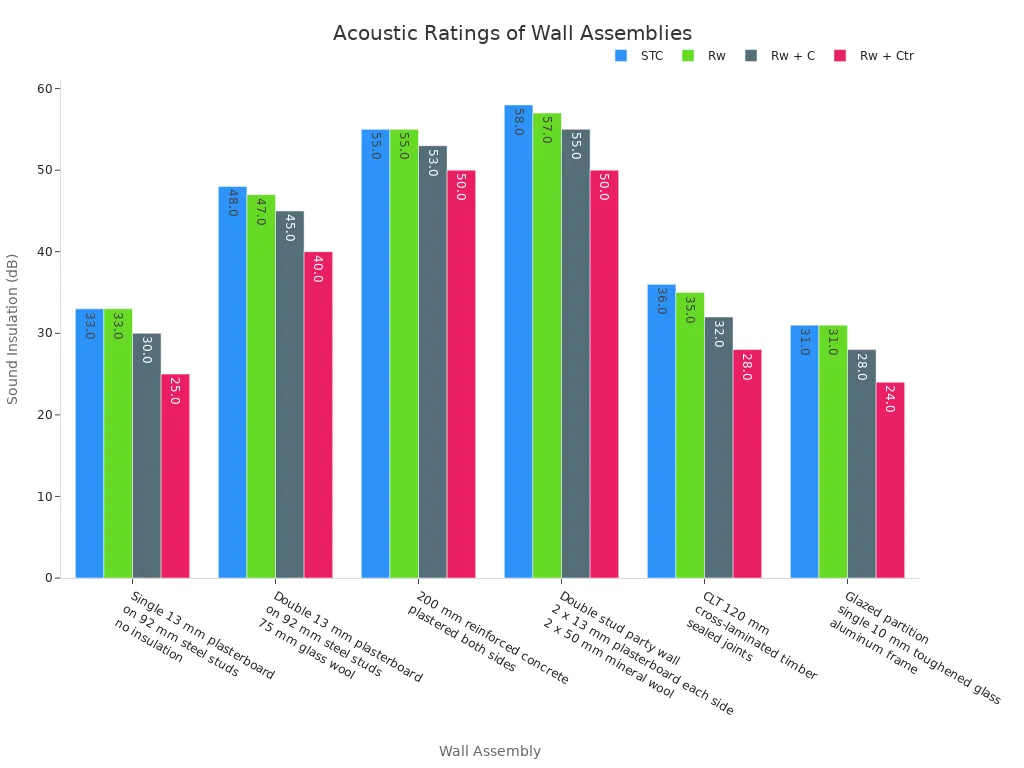
Ask for the test report with Rw (C; Ctr), not just Rw.
Safesmartenergy gives that advice, and it holds for facade work. Acousplan recommends requesting full one-third-octave data from 100 Hz to 5000 Hz. For sites near major roads or rail, specify Rw + Ctr as the primary metric. Impact sound data rarely appears for facade panels; buyers should request it where the assembly sits above occupied space.
A consistent document review and staged approval process helps buyers connect supplier claims to the materials and panels actually delivered.
Procurement starts with paper, not samples. Ask every candidate for product-level test reports that cover the exact build quoted. The fire report should name the manufacturer and production address, the product identification, the face and backing materials, the adhesive and decorative layers, the tested thickness, the mounting arrangement, and any classification limits. A metal-faced panel and a wood-veneered version do not share one classification by default.
Add emissions data, flatwise tensile and peel results, flatness tolerances, and the supplier's maximum format. Ask for project references on similar spans. For European work, confirm the CE marking route and the declaration behind it. RoHS covers restricted substances in electrical equipment, so it cannot stand in for fire or emissions evidence on a passive wall panel. A local building-code approval may also apply, and the supplier should say which document satisfies it.
Score each bid against the same five items: the exact panel construction, the applicable test standard, the certificate number, the issue and expiry dates, and the factory that will make the order. Those five separate a compliant supplier from a promising brochure. A panel-level fire classification for one construction does not carry over to every product in a range.
Then run a staged approval. Approve the finish, a cut-section sample, a production-size panel, and a representative wall mockup. Keep signed reference samples and inspect the first batch before shipment. Require a signed construction schedule with every quotation, and ban material substitution without written approval. This sequence protects non-combustible facade compliance on the facade and keeps fire performance traceable from certificate to crate.
Confirm face materials, core, adhesive, thickness, finish, and mounting arrangement.
Check the applicable fire, emissions, bonding, and acoustic standards.
Verify certificate numbers, laboratory details, issue dates, and expiry dates.
Identify the actual factory responsible for manufacturing the project order.
Approve finishes, cut sections, production-size panels, and representative mockups.
The first problem is still the same. Paperwork and what a supplier covers decide the shortlist, not fancy brochure claims. Four checks settle it: fire and emissions reports that match the quoted build, proven bond data, in-house making of oversized formats, and supply scale for full envelopes. Full-scope suppliers fit single-point facade contracts. Core specialists fit teams that keep design control.
WILLSTRONG, started in 1995, fits the full-scope profile. Its AHP system bonds a hexagonal aluminum honeycomb core between aluminum skins. It offers A2 fire performance and panels from 4 to 100 mm thick. It also supports deep processing for ultra-long panels, as at Xi'an's Zhongda International Mall.
Reliable facade performance depends on the work behind the finished panel: material selection, bonding control, dimensional accuracy, compliance documentation, fabrication, and delivery coordination.
Practical answers to common questions about qualifying large-format honeycomb panel manufacturers.
Ask for the test report and the classification document under EN 13501-1. The report shows what the lab tested. The classification names the product family and build that earned the rating. Check the tested core, adhesive, and finish against the quoted bill of materials. A claim without matching paperwork does not qualify.
Confirm the largest finished panel in the schedule, not the typical one. Ask for the press platen size, core expansion capacity, and finishing line length. A supplier who cannot cover the full sheet in one press pass will split the panel, and flatness tolerance drops at the seam.
A core specialist fits teams that keep design control and specify the core themselves. Plascore and Hexcel engineer bond behavior and panel mechanics at depth. A full-scope fabricator fits projects that need one accountable supplier for coating, edge closure, crating, and the sub-frame interface.
Specify Rw + Ctr for sites near roads or rail. Ctr adjusts for low-frequency traffic noise, and the term is zero or negative, so it lowers the headline Rw figure. Ask for one-third-octave data from 100 Hz to 5000 Hz under ISO 717-1, not a single Rw number.
Request panel-specific fire classification, emissions data, flatwise tensile and peel results under ASTM C297, flatness tolerances, maximum format, and project references on similar spans. Confirm the factory that will make the order. Score every bid against the same five items: construction, standard, certificate number, dates, and production site.