 Arabic
 Spain
 Germany
 France
 Japan
 Portuguese
 Russian
 Chinese
 Thailand
 Vietnam
 Indonesia
 India
News
The pioneer in facade solutions


The panel isn't the problem. The whole system is. Sound leaks through joints, frames, and gaps long before it crosses a honeycomb core. So sound failure rarely comes from one product. Buyers still need a short list, and these are the top suppliers covered here:
Technical performance covers the weighted sound reduction index (Rw) and spectrum adaptation terms (C/Ctr). Application fit asks whether a panel works for curtain walls, transport, or HVAC. Regulatory compliance checks building codes and fire performance. Cost-effectiveness weighs the value of the whole installed system, not the sticker price.

The essential points buyers should consider when comparing sound-insulating aluminum honeycomb panel suppliers and evaluating their products.
Top suppliers include Plascore, Pacific Panels, Flatiron, Gteek, Cheersbond, Hongzan, HW Honeycomb, and Advanced Structures.
Sound blocking depends on the whole system, including joints and frames, not just the panel.
Check the Rw and C/Ctr ratings to compare how well panels block different kinds of noise.
Pick the panel that fits your project: curtain walls, transportation, or HVAC each need different features.
Ask for test reports and fire certificates to check what a supplier says is true.
Comparing suppliers requires more than looking at product descriptions. Acoustic performance, application suitability, regulatory compliance, and installed cost all influence the final decision.
Sound insulation begins with physics, not marketing. Airborne sound hits a panel and makes it vibrate. The mass law says a heavier panel resists that motion better, so it blocks more sound. Air cavities inside the panel add another barrier, and damping layers turn vibration into heat before it crosses the core.
Hexagonal honeycomb cells trap still air between the skins, which raises transmission loss without adding much weight. Microperforated surfaces work in a different way: tiny pores soak up medium- and high-frequency sound instead of bouncing it back.
A supplier's published Rw and C/Ctr values show how a panel performs across real noise spectra, not just in a single test tone. Sound bridges at joints and frames can skip the core entirely, and impact noise travels a separate path through structure. So selection weighs the whole assembly, not the panel alone.
Application fit decides which panel construction makes sense. Curtain walls need stiffness and flatness across large spans. Transportation projects put fire safety and weight first. HVAC enclosures need absorption more than blocking.
Compliance then narrows the field. Panels made with an inorganic adhesive system can pass EN 13501-1 A2 and GB 8624 A2 non-combustibility tests, and European rail work often calls for EN 45545.
Cost-effectiveness looks at the installed system: framing, damping, and labor count as much as the panel price.
Fire classification and certification requirements vary according to the building type, application, and project location. The following standards provide a reference for supplier evaluation.
Standard | What it covers |
|---|---|
EN 13501-1 A2 | Non-combustible reaction to fire |
GB 8624 A2 | Chinese non-combustible classification |
EN 45545 | Fire resistance for rail vehicles |
These criteria give a steady basis for screening the top suppliers.
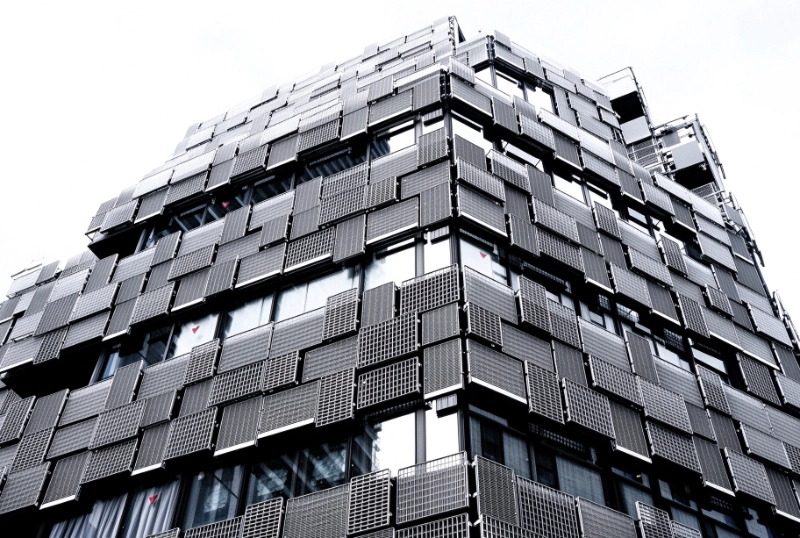
Different suppliers focus on different panel constructions, acoustic requirements, and application environments. Understanding these differences helps buyers identify suitable manufacturers.
Each core type blocks sound in its own way. Open pores in aluminum foam soak up medium- and high-frequency sound, while six-sided honeycomb cells trap air and stop sound from passing through. Suppliers build their panels around one or both of these methods.
Plascore offers honeycomb cores and finished sandwich panels in aluminum and other materials, with panel thicknesses from about [X] to [Y] mm. Their published acoustic data lists Rw values around [Rw], with C/Ctr terms of [C/Ctr]. Common uses include transport interiors and building cladding. Certifications cover [fire standard placeholder].
Pacific Panels supplies architectural honeycomb panels for facades and interiors. Panel builds range from [X] to [Y] mm, with Rw figures near [Rw] for standard assemblies. The company focuses on curtain wall and soffit work, and its compliance documents address [standard placeholder].
Flatiron Panel Products focuses on architectural and specialty panels, including perforated-skin acoustic types. Thickness options run from [X] to [Y] mm, with Rw around [Rw] where tested. Uses include ceilings, column cladding, and interior partitions.
Gteek builds panels for facades and transport. Core thickness, cell density, skin gauge, and coating chemistry each affect structural performance, durability, and cost, according to Chenshou Tech. Thicker skins add weight and cost; most facade applications do well with a 0.5 mm exterior skin, while ground-floor or vandalism-prone areas benefit from the 1.0 mm option.
PVDF coatings give better weather resistance and color stability than PE coatings, which suit interior or temporary structures.
Cheersbond and Hongzan both supply architectural honeycomb panels with [Rw placeholder] acoustic ratings and A2-oriented fire documentation. Cheersbond leans toward interior wall and ceiling systems; Hongzan serves facade and cladding projects.
HW Honeycomb Panels offers acoustic types with perforated skins or special cores for sound dampening, common in transportation interiors and sound studios.
Advanced Structures Corp. serves aerospace and defense-grade work, where certification and performance matter more than price.
Cost follows core geometry and skin choice. Smaller cell cores cost more because they use more material per area and weigh more per unit volume; larger cells suit applications where strength is not critical. Indexbox reports standard 3003 or 5052 alloy core at EUR 25–55 per square meter, architectural sandwich panels at EUR 120–280 per square meter, and aerospace grades at EUR 200–600 per square meter. Aluminum ingot and foil prices, energy, freight, and currency swings drive those figures.
Supplier | Best fit | Cost position |
|---|---|---|
Plascore | Transport and cladding | Mid to high |
Pacific Panels | Curtain walls | Mid |
Flatiron | Interior acoustics | Mid |
Gteek | Facades, transport | Mid |
Cheersbond | Interior systems | Mid |
Hongzan | Facade cladding | Mid |
HW Honeycomb | Studios, transit | Moderate vs. foam core |
Advanced Structures | Aerospace, defense | High |
HW Honeycomb panels cost more than ACP or solid-core composite, sit moderate against foam core, and often match or beat solid aluminum sheet for equal rigidity, per WW Aluminum. Aluminum-core acoustic panels suit airports, rail stations, hospitals, and fire-rated public buildings; paper-core versions fit dry office interiors and budget upgrades.
A side-by-side comparison helps identify each supplier's strengths across acoustic performance, fire classification, panel thickness, application suitability, and relative cost.
A side-by-side view shows where each supplier's strengths sit. The table below draws on published data and the criteria set earlier in this article.
Supplier | Rw range | Fire rating | Thickness range | Best-fit application | Relative cost |
|---|---|---|---|---|---|
Plascore | [Rw placeholder] | [standard placeholder] | [X]–[Y] mm | Transport, cladding | Mid to high |
Pacific Panels | [Rw placeholder] | [standard placeholder] | [X]–[Y] mm | Curtain walls | Mid |
Flatiron | [Rw placeholder] | [standard placeholder] | [X]–[Y] mm | Interior acoustics | Mid |
Gteek | [Rw placeholder] | A2-oriented | [X]–[Y] mm | Facades, transport | Mid |
Cheersbond | [Rw placeholder] | A2-oriented | [X]–[Y] mm | Interior systems | Mid |
Hongzan | [Rw placeholder] | A2-oriented | [X]–[Y] mm | Facade cladding | Mid |
HW Honeycomb | 21–25 dB | [standard placeholder] | 6–25 mm | Studios, transit | Moderate |
Advanced Structures | [Rw placeholder] | [standard placeholder] | [X]–[Y] mm | Aerospace, defense | High |
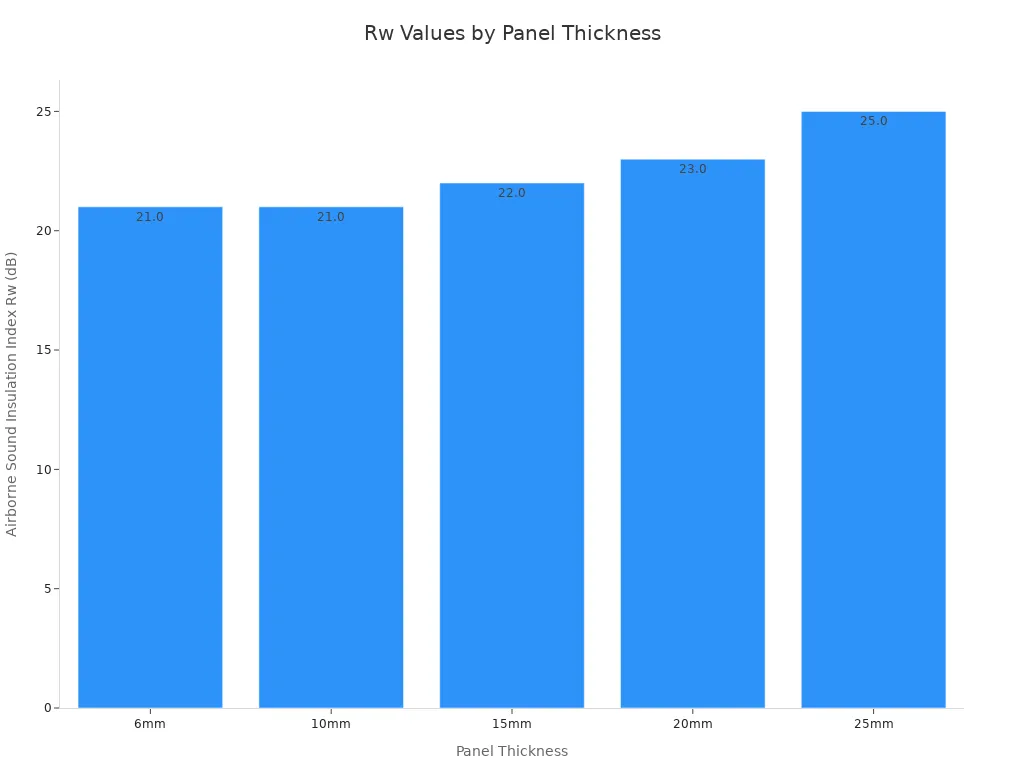
HW Honeycomb Panels publishes Rw values that go up as the panel gets thicker. A 6 mm or 10 mm build rates 21 dB, and a 15 mm build reaches 22 dB. A 20 mm build hits 23 dB, while a 25 mm build tops out at 25 dB. The chart below, from HW Honeycomb Panels, shows that progression.
Few suppliers share C/Ctr terms openly. Buyers should ask for them directly, because one Rw figure hides how a panel handles low-frequency traffic or engine noise.
Every gain comes with a cost. More mass lifts Rw, but it adds structural load and calls for stronger framing. Thicker cavities help low-frequency performance, yet they make the assembly deeper and harder to install at reveals and corners. Smaller honeycomb cells raise stiffness and price at the same time, per Indexbox.
Aerospace grades reach EUR 200–600 per square meter, while architectural panels sit at EUR 120–280 per square meter.
The top suppliers each balance these factors in different ways, so the right pick depends on the project's noise spectrum, span, and budget rather than a single score.
Supplier selection should start with the intended application and continue through system engineering, installation details, and project-specific performance verification.
The right use quickly narrows the list. Curtain wall jobs need flat, stiff panels and A2 fire papers. Foshan City Linwell Honeycomb Hardware, a custom maker with 10 years of experience, lists A2 fireproof and sound-insulating panels for outside walls, offices, hospitals, and malls, per Alibaba.
Transit work rewards control of vibration. 3A Composites updated its ALUCORE panel in July 2023 with better vibration-damping for rail cars and intercity buses, according to Market Research Future. Alucoil supplies panels with a high stiffness-to-weight ratio for transit interiors. HVAC enclosures lean toward absorption, where perforated or foam cores help.
Curtain wall jobs need flat, stiff panels and A2 fire papers.
Facade SystemsTransit work rewards control of vibration. Panel weight and vibration-damping characteristics are important considerations.
Transport InteriorsHVAC enclosures lean toward absorption, where perforated or foam cores help.
Acoustic EnclosuresBudget changes the mix again. Aerospace-grade panels sit at the top of the price range, architectural panels in the middle, and paper-core builds at the entry level. A buyer with a tight budget should spend on joints and damping before upgrading the panel.
Aluminum honeycomb panel also has the advantages of sound insulation and heat insulation, notes Arrow Dragon.
Architects see panels. Engineers see systems. Sound performance lives in the core, the damping layer, the cavity, the connections, and the installation. A panel with a strong Rw rating still leaks sound through a weak frame or an unsealed joint. So the supplier review should ask how the panel joins the sub-frame, how the cavity is closed, and who owns the interface details.
WILLSTRONG offers one checked option here. It puts the aluminum honeycomb core, skins, and sub-frame into one prefab system, with A2 fire performance, 4–20mm interior and 20–100mm exterior thicknesses, and sound and heat insulation. The Zhongda International Mall in Xi'an shows the system in a real cladding job. Buyers should still test every supplier against their own noise spectrum, code path, and budget.
Supplier | Strongest criterion |
|---|---|
Plascore | Range for transport and cladding |
Pacific Panels | Fit for curtain walls |
Flatiron | Interior acoustic builds |
Gteek | Balance of facade and transit |
Cheersbond | Interior systems |
Hongzan | Facade cladding |
HW Honeycomb | Published Rw progression |
Advanced Structures | Aerospace certification |
Each of these top suppliers leads on a different criterion. Readers should weigh them against their own application, code path, and budget.
WILLSTRONG's prefabricated core, skin, and sub-frame assembly shows that logic in practice.
Test the system, not the datasheet.
Practical answers to common questions about acoustic ratings, panel thickness, cost, and supplier verification.
Rw is a single-number rating of airborne sound insulation. A lab tests the panel across frequencies and shifts the curve to a reference contour. The result tells readers how well a product blocks speech and similar mid-frequency noise. Rw alone hides low-frequency performance, so engineers pair it with C and Ctr.
C and Ctr are spectrum adaptation terms. They adjust the base Rw rating for real noise sources. Ctr penalizes weak low-frequency performance, which matters for engines, rail cars, and city traffic. Two panels with the same Rw can behave very differently once Ctr applies. Buyers should request both values in writing.
Thickness helps, but the gain is gradual. HW Honeycomb Panels publishes 21 dB at 6 mm and 10 mm, 22 dB at 15 mm, 23 dB at 20 mm, and 25 dB at 25 mm. Each step adds mass and cavity depth. Deeper builds improve blocking, yet they raise weight, cost, and installation depth.
Core geometry and skin choice drive cost. Indexbox reports standard alloy core at EUR 25–55 per square meter, architectural sandwich panels at EUR 120–280, and aerospace grades at EUR 200–600. Smaller cells use more material per area. Thicker skins add weight and cost, so most facades use a 0.5 mm exterior skin.
Ask for a test report from a recognized lab, not a datasheet summary. The report should list Rw, C, and Ctr for the full assembly, including joints and framing. Check fire papers against EN 13501-1 A2, GB 8624 A2, or EN 45545 where rail work applies. Confirm the tested build matches the delivered build.
A rating describes a specimen. A building describes a system.
The right acoustic panel is the one that performs as part of the complete building assembly.
The top suppliers covered in this article offer different strengths across transport, architectural cladding, interior acoustics, and specialized applications. Buyers should compare verified acoustic data, fire documentation, application suitability, and installed system cost before making a final decision.
Rw and C/Ctr provide useful starting points, but they cannot describe every connection, cavity, frame, and installation detail. A reliable evaluation therefore considers the complete panel assembly and confirms that the tested configuration matches the delivered product.