 Arabic
 Spain
Spain Germany
 France
 Japan
Japan Portuguese
 Russian
 Chinese
 Thailand
 Vietnam
 Indonesia
 India
IndiaNews
The pioneer in facade solutions


A facade fire is often described by one question: How fast do the flames spread?
A facade fire is often described by one question:
How fast do the flames spread?
It is an important question, but it is not the only one.
In a real building fire, occupants and firefighters may also face dense smoke, toxic combustion gases, intense heat transfer, and loss of material integrity. A facade that limits visible flame spread can still create serious risks if its materials generate large amounts of smoke, release hazardous gases, or allow excessive heat to pass through the assembly.
Fire safety is not just about stopping flames. It is about controlling what heat and combustion products do to the building.
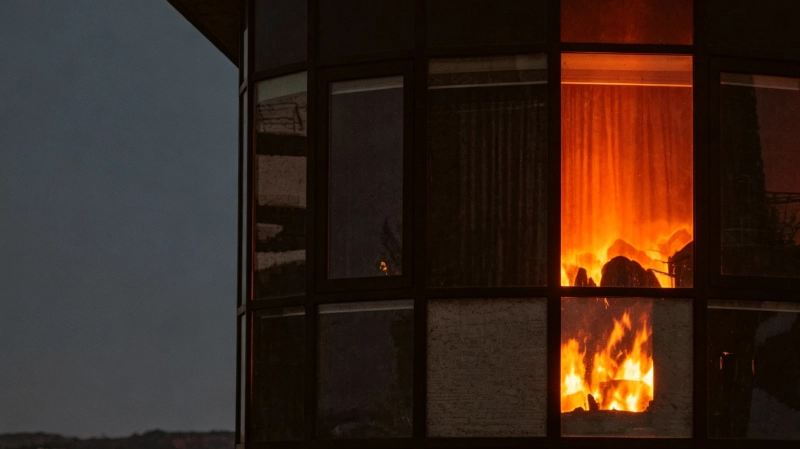
Flame spread is an important part of facade fire behavior, but smoke, hot gases and combustion products can create separate pathways and risks.
Consider a fire involving an exterior wall.
The first visible concern is usually the flame.
Does the flame spread across the facade?
Does it move upward?
Does the cladding continue burning?
These observations are important because flame spread can accelerate the development of a facade fire.
But smoke can travel differently from flames.
Hot gases can move through cavities, openings, joints and ventilation paths. Smoke may enter occupied areas before the facade itself shows extensive flame involvement.
This creates a practical problem for facade design.
A material may show limited flame propagation under a particular test condition, while its combustion products still need to be considered separately.
That is why smoke density matters. Dense smoke can reduce visibility, complicate evacuation, affect firefighting operations and indicate that significant thermal decomposition is taking place.
The question is therefore not simply:
“Will the material burn?”
It is also:
“What happens when the material is exposed to heat?”
Fire behavior involves flame, smoke and gas release, while the response of the material depends on its chemistry and the conditions surrounding combustion.
When a polymer-containing material is exposed to sufficient heat, it can undergo thermal decomposition.
The resulting products depend on the material chemistry, temperature, oxygen availability and combustion conditions.
Some materials can produce large quantities of smoke.
Others may release gases that are hazardous when inhaled.
The actual risk depends on the composition of the material and the conditions under which it burns or decomposes, which is why laboratory testing and product documentation matter.
For facade engineers, this leads to three separate questions:
1. Flame behavior — Does the material support flame spread?
2. Smoke behavior — How much smoke is produced under the relevant test conditions?
3. Gas release — What combustion or decomposition products may be generated?
These characteristics are related, but they are not interchangeable.
A flame-spread result does not automatically describe smoke behavior.
A fire classification does not necessarily provide every detail about toxic gas exposure.
And a material's resistance to ignition does not mean that heat transfer through the facade is insignificant.
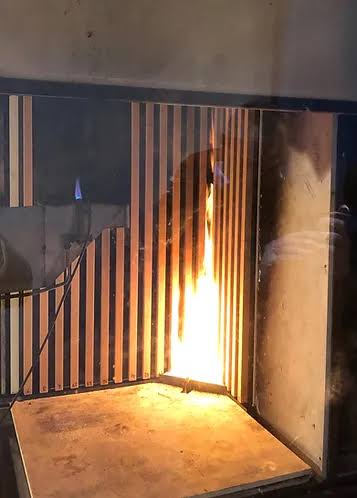
Smoke is less visually dramatic than flames, but its effect on visibility, evacuation and firefighting can make it a primary fire-safety concern.
Smoke is sometimes treated as a secondary effect because it is less visually dramatic than flames.
In building evacuation, however, smoke can become a primary hazard.
High smoke density can reduce visibility along escape routes. It can make signs, doors and obstacles harder to identify.
For facade systems, smoke behavior should therefore be considered together with the building's overall fire strategy.
The relevant question is not simply whether the exterior panel produces smoke in isolation.
Engineers should consider where smoke can travel.
Can it enter through window openings?
Can it move through the facade cavity?
Can joints or penetrations provide a route into another building zone?
Can smoke bypass a fire barrier?
This is another reason facade fire safety needs to be evaluated at the system level.
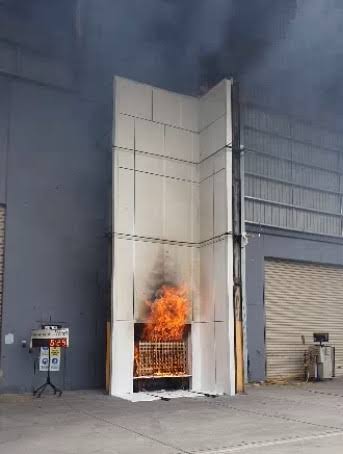
The chemistry inside a facade panel can influence combustion products, making the core material an important part of fire evaluation.
Flame is visible.Toxic gas is not.
During a fire, materials can release combustion products that may be harmful when inhaled. The type and quantity depend strongly on the material composition and the conditions of combustion.
For this reason, toxic gas release should not be treated as a generic property of all facade materials.
Different core materials can behave very differently when exposed to heat.
A material designed to reduce combustibility may have a different thermal decomposition behavior from a highly organic core. The distinction becomes particularly important for composite panels because the core occupies a large volume between the aluminum skins.
This is where the concept of core material becomes central.
The aluminum surface is visible from outside.
The core often determines a significant part of how the panel responds when exposed to fire.
That means facade evaluation should move beyond the surface and ask what is inside the panel.
Self-extinguishing behavior is one useful engineering characteristic, but it must be understood within the limits of the relevant test conditions.
One useful property to consider is whether the core material self-extinguishes after the ignition source is removed.
This does not mean that a self-extinguishing material is automatically non-combustible or that it eliminates all fire risks.
It means that, under the specified test conditions, the material may stop sustaining combustion once the external ignition source is no longer present.
This distinction is important.
Imagine two materials exposed to an external flame.
The first material continues supporting combustion after the ignition source is removed.
The second material stops sustaining combustion when the ignition source is removed.
In facade engineering, this property can help engineers understand whether a material is likely to contribute to continued burning under particular conditions.
But it should be evaluated together with the full fire classification, heat release, smoke production and assembly-level performance.
Heat can move through a facade even when visible flame spread is limited, making thermal insulation another important part of fire evaluation.
There is another part of facade fire safety that is easy to overlook:heat transfer.
A facade does not need to be visibly burning to transfer significant heat.
When one side of a panel is exposed to high temperatures, heat can conduct through the panel structure and raise the temperature on the opposite side.
The rate of heat transfer depends on factors such as material conductivity, thickness, density, geometry, joints and the overall facade assembly.
Good thermal insulation is not simply about improving energy efficiency during normal building operation. In a fire scenario, insulation characteristics can influence how quickly heat reaches adjacent components or spaces.
For a composite facade, the core therefore has multiple engineering functions.
It contributes to the panel's weight and stiffness.
It affects thermal performance.
It affects fire behavior.
And it interacts with the aluminum skins, adhesives, coatings and support structure.
Changing the core is therefore not simply a material substitution.
It can change the behavior of the entire panel.
Different fire processes can develop at different speeds, so facade performance should not be reduced to one visible event.
This leads to a useful way to think about facade fire safety.
During a fire, several processes can happen at different speeds.
Flame can spread.
Smoke can accumulate.
Heat can transfer.
Materials can decompose and release gases.
Connections and surrounding components can lose performance.
These processes do not necessarily occur at the same time or at the same rate.
A facade that performs well in one aspect may still require attention in another.
This is why engineers should avoid reducing fire safety to a single question such as “Is the panel fireproof?”
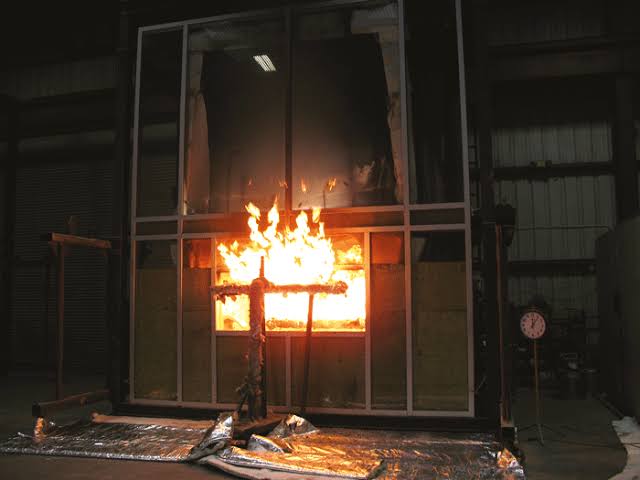
That includes ignition, flame spread, heat release, smoke generation, gas release, self-extinguishing behavior and heat transfer.
The answer should then be connected to the actual facade construction.
A practical facade evaluation should move from the core material to the complete panel and finally to the installed assembly.
What is the core made from?
What is its fire classification?
How does it behave when exposed to an ignition source?
Does it continue burning after the external flame is removed?
What are the available test results for smoke and heat release?
How are the aluminum skins bonded to the core?
What coatings, adhesives or other layers are included?
Could these components affect the fire behavior of the finished panel?
How is the panel connected to the structure? What is behind it? Is there a cavity? What insulation is used? Where are the joints? What happens at windows, slab edges and penetrations?
This approach prevents a common mistake:
evaluating a fire-resistant material without evaluating the conditions in which that material will actually be used.
Test reports are most useful when the project team understands exactly what each test measures and how the result relates to the intended application.
For facade projects, test reports are most useful when engineers understand what each test is actually measuring.
A fire test may address flame propagation.
Another may evaluate heat release.
Another may provide information about smoke generation.
Another may examine ignition or combustion characteristics.
These results should not be treated as interchangeable.
A supplier's technical documentation should therefore help project teams identify which properties have been tested and under which standards and conditions.
For a composite facade system, this information becomes especially important when the project specification requires a particular fire classification or when the building has strict requirements for exterior wall construction.
Product selection becomes more meaningful when materials are considered as part of the engineering requirements of the complete facade.
This is where WILLSTRONG® can be introduced as part of the engineering discussion rather than as the starting point.
Established in 1995, WILLSTRONG® works across aluminum composite panels, fire-resistant composites and aluminum honeycomb systems.
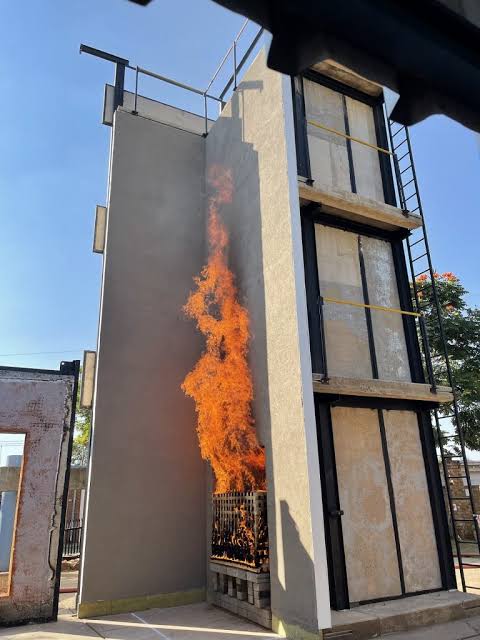
Its fire-resistant composite panels can be considered where facade projects require attention to the core material, panel fire behavior and thermal performance as part of the overall envelope design.
The company's published fire test reports provide supporting technical information for evaluating specific material performance rather than relying only on general descriptions such as “fireproof.”
For engineers, the useful question remains the same:
That question keeps product selection connected to engineering requirements.
The following questions can help project teams evaluate facade materials beyond broad marketing terminology.
When comparing facade materials, several questions can help move the discussion beyond marketing terminology.
Do not evaluate the aluminum skin alone. Understand the composition and role of the core.
Check whether the relevant material shows self-extinguishing behavior under the specified test conditions.
Identify the standard, test method, specimen and classification rather than relying only on a general fire rating.
Where project requirements make it relevant, review available information on smoke generation and smoke density.
Consider the thermal insulation properties of the core and the complete facade assembly.
A material test cannot automatically validate a different panel construction or a different facade assembly.
This last question is often the most important.
Fire safety is not a label attached to one material.
It is a performance requirement that has to be translated into the actual building envelope.
Fire safety begins with understanding what happens beyond the visible flame.
A flame is what we see first.
Smoke, toxic gases and heat are what engineers must see beyond it.
A safer facade is not simply one that limits flame spread. It is one whose materials, core, insulation and construction are understood under the conditions a real fire can create.
Good fire engineering begins where the visible flame ends.