 Arabic
 Spain
 Germany
 France
 Japan
 Portuguese
 Russian
 Chinese
 Thailand
 Vietnam
 Indonesia
 India
News
The pioneer in facade solutions


A facade coating can look smooth and uniform when panels leave the production line, yet develop blisters or cracks after installation. These defects may appear months or years later, often in areas exposed to strong sunlight, repeated wetting or significant temperature changes.
For building owners, the immediate concern is appearance. For facade engineers, the more important question is what has failed beneath the visible surface.
Blistering and cracking are not interchangeable defects, and neither has a single universal cause. They can result from inadequate surface preparation, poor coating adhesion, incorrect curing, excessive film thickness, substrate movement or long-term environmental exposure. In some cases, several factors interact.
Understanding the failure mechanism is the first step toward preventing recurrence. Repainting a defective surface without identifying the underlying cause may improve its appearance temporarily while leaving the original problem unresolved.
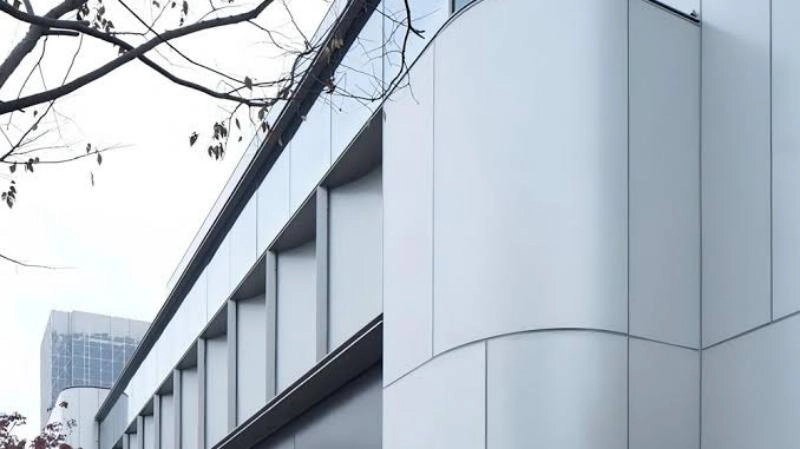
Blistering and cracking have different physical characteristics. Identifying the type of defect helps narrow down the possible failure mechanisms.
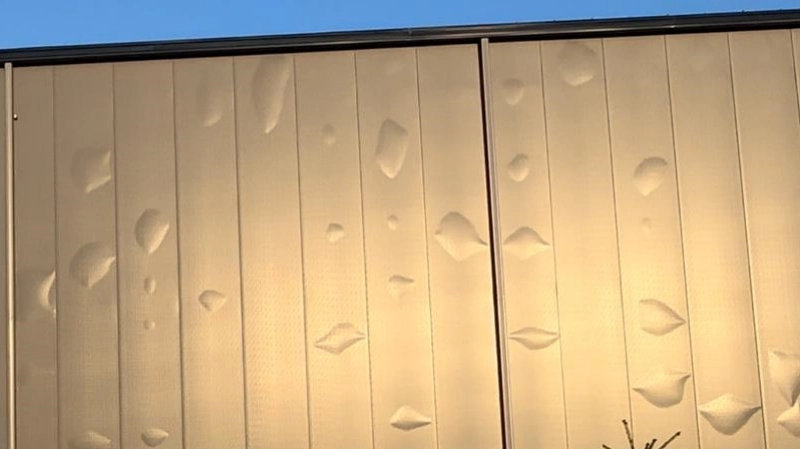
Blistering appears as localized bubbles or raised areas in a coating. These defects can develop when adhesion is weakened or when pressure builds beneath the coating and causes it to separate from the underlying surface or another coating layer.
Cracking is different. It occurs when the coating can no longer accommodate the stresses imposed on it. The cracks may remain within the coating film or extend through multiple layers, depending on the mechanism and severity.
On aluminum composite panel facades, both defects deserve attention because the coating is part of a larger building-envelope system. A visible defect can indicate a manufacturing problem, an environmental durability issue or a mismatch between material behavior and service conditions.
However, appearance alone does not establish the cause. A blister does not automatically prove that moisture entered the panel, and a crack does not necessarily mean that the PVDF content is too low.
The correct diagnosis starts with the location, pattern, timing and depth of the defect.
Surface preparation, moisture, curing conditions, film thickness and thermal movement can all influence coating performance.
A coating must adhere reliably to the surface beneath it. On aluminum substrates, surface cleanliness and the condition of the treated surface are critical to this bond.
Oil, dust, residual processing chemicals or other contaminants can interfere with adhesion. If the surface treatment is inadequate or inconsistent, the coating may not establish the intended bond with the substrate.
The same principle applies between coating layers. Poor intercoat compatibility, contamination between application stages or an unsuitable coating process can create a weak interface.
When adhesion is compromised, environmental exposure and mechanical stress may cause localized separation. If moisture or other substances can enter through an existing defect or vulnerable interface, the problem may become more pronounced.
This is why simply applying another coat over a blister is rarely a reliable repair strategy. Unless the weak interface is identified and corrected, the new coating may fail in the same area.
For quality control, surface preparation should be treated as a controlled production process, not as an informal cleaning step. Relevant checks may include surface condition, pretreatment parameters, cleanliness and compliance with the coating manufacturer's process requirements.
Moisture can contribute to blistering, but the mechanism depends on the coating system and the conditions involved.
Water may reach a vulnerable interface through defects, exposed edges or other pathways. Under certain conditions, moisture accumulation, changes in local pressure or reduced adhesion can promote the formation and growth of blisters.
Heat can intensify some of these effects. When a facade surface heats up under sunlight, temperature changes can influence moisture movement, pressure and the mechanical behavior of the coating system.
Nevertheless, not every blister is moisture-driven. Trapped contamination, inadequate curing, incompatible layers or other manufacturing defects may produce similar visible symptoms.
The distinction matters during investigation. If the actual cause is contamination or a weak intercoat bond, addressing only water exposure will not solve the problem.
A useful diagnostic approach is to examine the blister distribution, inspect the exposed interface and compare affected areas with sound areas. Where necessary, laboratory analysis can help identify residues, layer separation or other evidence relevant to the failure mechanism.
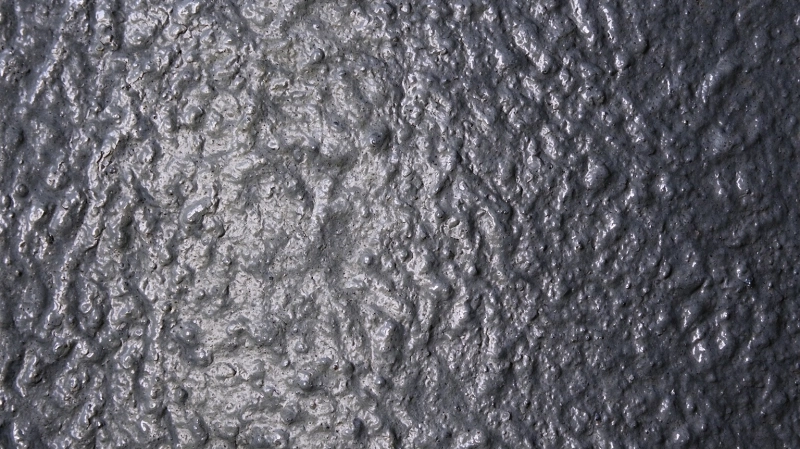
Coating thickness affects both protection and mechanical behavior.
If the film is too thin, coverage may be insufficient for the intended application, potentially leaving vulnerable areas. If it is excessively thick, the coating may be more difficult to cure uniformly or may develop stresses that contribute to defects, depending on the formulation and application process.
The appropriate thickness is therefore the specified range for the complete coating system, not simply the maximum achievable value.
Curing is equally important. Coatings are formulated to develop their intended properties under defined processing conditions. Insufficient curing can leave the film with properties different from those expected, while excessive or otherwise unsuitable thermal exposure may also affect some formulations.
For coil-coated aluminum panels, production controls should consider the actual metal temperature and time at the required conditions, rather than relying solely on the oven's air-temperature reading.
When investigating a failure, useful records include coating thickness measurements, production-line settings, curing records, batch information and relevant quality inspection results. These records can help determine whether the defect is associated with a particular production run or process variation.
Aluminum facade systems experience temperature changes throughout the day and across seasons. Aluminum expands as it heats and contracts as it cools. The coating and the underlying material must accommodate the resulting dimensional changes without developing unacceptable stress.
Repeated thermal cycling can place stress on the coating, especially when the film has limited flexibility, the coating layers are poorly bonded or the system contains existing defects.
Long-term ultraviolet exposure can also degrade susceptible coating components. As the coating ages, its mechanical properties may change, potentially reducing its ability to accommodate movement. Depending on the formulation and exposure conditions, the surface may become more vulnerable to cracking.
The facade assembly adds another consideration. Panel dimensions, fixing details, joints and installation tolerances influence how movement is accommodated by the overall system. If the panel or its supporting assembly is restrained in a way that creates excessive local stress, the resulting movement may contribute to damage.
This does not mean that every coating crack originates in the facade structure. The failure must be assessed in context, distinguishing coating deterioration from movement-related stress and other possible causes.
Reliable diagnosis requires more than a visual inspection. Investigators need to establish where, when and how the coating failure developed.
A blister or crack is evidence of a problem, but it is not a complete diagnosis.
Two panels may show similar defects for entirely different reasons. One may have poor adhesion caused by inadequate surface preparation; another may have developed stress-related cracking after prolonged weathering. Applying the same repair method to both could produce very different results.
A systematic investigation should answer four questions:
Determine whether separation is at the substrate interface, between coating layers or within the coating film.
Defects noticed during production, after transport, shortly after installation or after years of exposure may point toward different mechanisms.
Clustering by batch, elevation, panel edge or exposure direction can help narrow the possible causes.
Coating thickness measurements, adhesion testing, production records, visual examination and appropriate laboratory analysis may be needed to verify the suspected mechanism.
Adhesion testing, for example, can help assess the strength of a coating bond under a specified method. However, the result must be interpreted with care: the failure location and mode can be as informative as the measured value itself. A test on an unaffected area also may not represent the condition of a defective interface.
Similarly, a coating that meets its original thickness requirement can still fail if the surface preparation or curing process was inadequate.
A repair method should follow a supported diagnosis of the defect. Treating the visible surface without correcting the underlying problem may leave the original failure mechanism active.
Coating reliability depends on controls that begin with material specification and continue through production, installation and inspection.
Preventing coating defects begins before production and continues through installation and inspection.
Specify the required coating type, layer structure, film thickness and applicable performance requirements. Avoid relying on a generic product description when the project requires a defined technical system.
Establish process requirements for cleaning and pretreatment, and maintain inspection records. The purpose is to ensure that the coating is applied to a surface suitable for reliable adhesion.
Monitor coating thickness, production conditions and curing parameters according to the coating manufacturer's requirements. Use records that allow deviations to be traced to specific production batches.
Visual inspection can identify obvious defects, but it should be supplemented by appropriate measurements and tests when required by the specification. Any adhesion or durability test should use a defined method and acceptance criteria.
Consider panel movement, joint design, fixing conditions, edge details and installation tolerances. A durable coating cannot compensate for an assembly that imposes inappropriate mechanical stress on the panel.
Document the location and extent of defects, preserve representative samples where practical and establish the likely cause before selecting a repair procedure. The appropriate response may differ depending on whether the problem originates in manufacturing, installation or environmental exposure.
These controls create a clearer link between material specification, production quality and long-term facade performance.
Supplier assessment should consider technical documentation, production controls, traceability and the requirements of the complete facade assembly.
For architects, facade contractors and procurement teams, supplier evaluation should go beyond a product brochure or a small color sample.
First, confirm that the proposed coating system is clearly identified and that its technical documentation matches the project requirements. Where relevant, review the specified film thickness, curing controls, adhesion requirements and weathering performance.
Second, ask how production quality is monitored. A supplier should be able to explain how surface preparation, coating application and curing are controlled, and what records are available when a defect needs to be investigated.
Third, clarify how nonconforming material is handled. Traceable batch records and documented inspection procedures make it easier to determine whether a problem is isolated or affects a wider production group.
Finally, evaluate whether the supplier understands the panel's role within the facade assembly. Coating reliability is important, but the final result also depends on appropriate panel selection, detailing, installation and movement accommodation.
The most useful supplier relationship is one that supports technical verification and root-cause investigation rather than relying on appearance claims alone.
Material selection and coating verification should be connected to the actual exposure conditions and technical requirements of each facade project.
WILLSTRONG®, established in 1995, works with aluminum composite panels, fire-resistant composite materials and aluminum honeycomb systems.
For projects specifying aluminum composite panels, coating selection should be connected to the required surface finish, environmental exposure and production controls. Project teams should verify the proposed coating specification and request supporting documentation for the performance requirements that matter to the application.
WILLSTRONG®'s facade project portfolio includes projects such as Charles de Gaulle International Airport. Such references provide context for the company's involvement in architectural facade applications, while the exact coating system and technical requirements for each new project should be verified separately.
The objective is to establish a documented connection between the selected material, the manufacturing process and the conditions the facade will experience in service.
Blistering and cracking can arise from different mechanisms, including poor adhesion, inadequate surface preparation, unsuitable curing, film-thickness variation and long-term environmental stress.
No single coating parameter can prevent every failure. Reliable performance depends on the interaction between the coating formulation, substrate condition, production controls and the movement and exposure conditions of the installed facade.
For project teams, the practical priority is to specify measurable requirements, verify production quality and investigate defects before deciding how to repair them.