 Arabic
 Spain
 Germany
 France
 Japan
 Portuguese
 Russian
 Chinese
 Thailand
 Vietnam
 Indonesia
 India
News
The pioneer in facade solutions


A facade panel becomes lighter, the supporting structure carries less dead load, and installation becomes easier. On paper, this looks like an obvious improvement. But when the same project has strict acoustic requirements, another question appears: can a lightweight facade provide sufficient sound insulation without simply adding more material?
This is where the traditional mass law creates an engineering challenge. Increasing surface mass generally improves airborne sound insulation, yet modern facade design increasingly demands lighter panels, reduced structural loads, and more efficient installation.
Aluminum honeycomb panels sit directly at this intersection. Their sandwich construction offers high bending stiffness at relatively low weight, but structural efficiency and acoustic insulation are not the same thing. Understanding that difference is essential when selecting panels for buildings exposed to traffic, aircraft, or urban environmental noise.
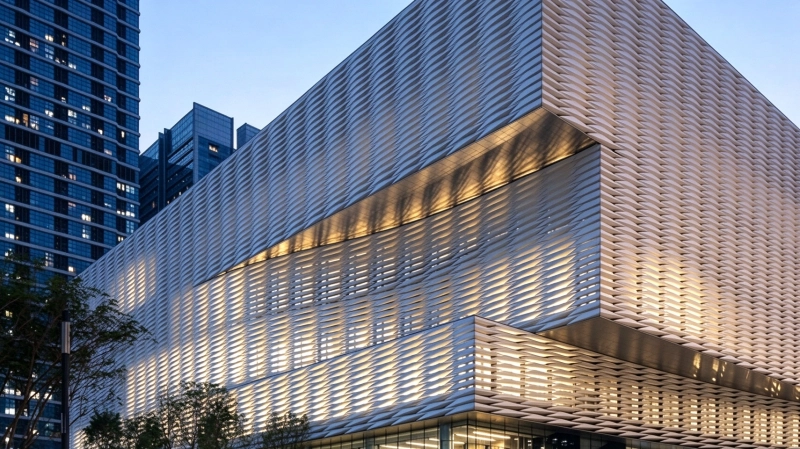
Understanding the relationship between surface mass and airborne sound insulation provides the starting point for evaluating lightweight facade systems.
The mass law describes a general relationship between the surface mass of a barrier and its ability to reduce airborne sound transmission.
For a simple, homogeneous panel under idealized conditions, increasing surface mass makes it harder for incident sound pressure to accelerate the panel. As a result, less acoustic energy is transmitted to the other side.
Surface mass is expressed in kilograms per square meter (kg/m²). For a single-leaf panel operating within the mass-controlled region, doubling its surface mass can theoretically increase sound insulation by approximately 6 dB at a given frequency, subject to the assumptions of the mass-law model.
This explains why thick concrete walls, masonry, and other heavy construction elements often provide substantial airborne sound insulation.
However, the mass law is not a universal prediction formula for every facade assembly. Real panels have bending stiffness, natural vibration modes, damping, and frequency-dependent behavior. Their connections and boundary conditions also affect sound transmission.
The problem becomes clear when architects and facade engineers try to apply traditional heavy-wall acoustic principles to lightweight cladding. Simply increasing panel thickness or adding dense materials may improve some acoustic properties, but it also increases dead load and can affect the entire facade support system.
Increasing panel weight affects more than the material itself. It changes the demands placed on the supporting structure, connections, transportation, and installation process.
A heavier facade panel does not operate independently of the building. Its weight must be transferred through brackets, rails, anchors, and supporting structural members.
As panel mass increases, several engineering considerations become more demanding.
Additional panel weight increases the permanent load carried by the facade support system and the building structure. Brackets, anchors, and supporting members may need to be redesigned.
Facade systems must resist wind pressure and suction. Panel weight and wind resistance are different load cases, but both influence the design of connections and support spacing. A heavier panel does not automatically perform better under wind loading.
Large, heavy panels require more careful lifting, handling, and installation arrangements. This can affect installation speed, equipment selection, and site logistics.
Heavy components can be more difficult to position and adjust, particularly on large facades where dimensional deviations accumulate across multiple panels.
Metal facade components expand and contract with temperature changes. The connection system must accommodate this movement without introducing excessive stress or compromising joint performance.
These constraints explain why lightweight construction has become increasingly important in contemporary facade engineering. The objective is not simply to remove material, but to maintain the required structural and environmental performance with less mass.
Sandwich construction separates the structural role of the facing sheets and core, creating a stiff panel without using a solid metal section of equivalent thickness.
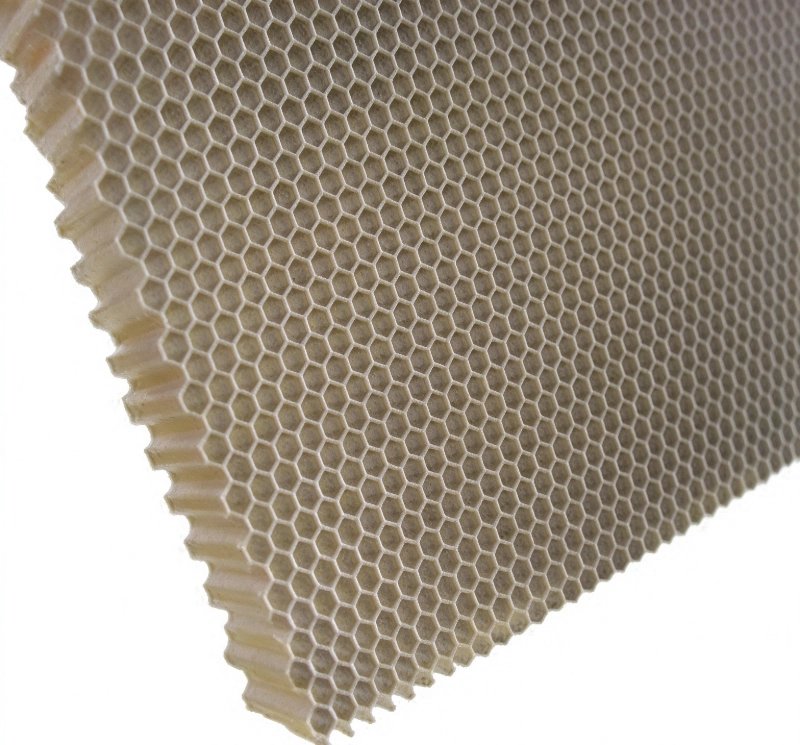
An aluminum honeycomb panel typically consists of two facing sheets bonded to a lightweight honeycomb core.
The two facing sheets carry much of the bending stress, forming the outer structural layers of the sandwich panel.
The core separates the facing sheets and helps maintain their relative position, contributing to the panel's overall structural efficiency.
The bonding system connects the facing sheets and core, helping transfer forces and maintain the integrity of the sandwich construction.
The two facing sheets carry much of the bending stress, while the core separates them and helps maintain their relative position. This sandwich arrangement increases the panel's effective bending stiffness without requiring a solid metal section of equivalent thickness.
The core also contributes to shear transfer between the facing sheets and helps resist local deformation, depending on the panel design and bonding quality.
The result is a relatively lightweight panel with useful stiffness and dimensional stability for facade applications.
However, the core's structural function must not be confused with sound absorption.
A conventional aluminum honeycomb core is not automatically an effective acoustic absorber. Its cellular geometry primarily serves structural purposes. Unless specifically designed and tested for acoustic absorption, it should not be assumed to dissipate significant sound energy.
Nor does high bending stiffness automatically mean high airborne sound insulation. A stiff panel can still transmit sound efficiently within certain frequency ranges, depending on its mass, vibration characteristics, and boundary conditions.
Two acoustic mechanisms are particularly important when evaluating lightweight sandwich panels: resonance and coincidence.
Every panel has natural frequencies at which it tends to vibrate. These frequencies depend on its dimensions, mass, bending stiffness, support conditions, and construction.
When incident sound excites a panel near one of its natural frequencies, vibration amplitude may increase. This can create a frequency band in which sound transmission becomes more pronounced.
The coincidence effect occurs when bending waves travelling through a panel interact efficiently with airborne sound waves at certain frequencies.
At this point, the panel may radiate sound more effectively, resulting in a dip in sound insulation.
For honeycomb panels, the behavior is influenced by the facing sheet thickness, core depth, core geometry, bonding layer, and the way the panel is supported.
Changing one parameter may improve stiffness while also shifting the panel's vibration modes. Therefore, a structural modification should not be assumed to improve acoustic performance automatically.
The critical frequency is related to the panel's bending stiffness and surface mass. This is why a panel's acoustic response cannot be predicted from thickness or total weight alone.
For lightweight facade panels, engineers should examine frequency-dependent test data to identify possible weak bands rather than relying exclusively on a single weighted rating.
When increasing surface mass is not practical, damping and separated construction offer alternative ways to manage the acoustic behavior of facade assemblies.
If adding mass is not always practical, how can engineers improve the acoustic behavior of lightweight facade assemblies?
One approach is to control vibration through damping.
Damping materials dissipate part of the mechanical energy associated with panel vibration. Depending on their properties and placement, they can reduce resonance peaks and limit vibration amplitude over certain frequency ranges.
However, damping is not a universal fix. Its effectiveness depends on the material's loss factor, operating temperature, bonding conditions, frequency range, and integration into the panel assembly.
Another approach is to introduce multiple layers.
A separated double-leaf construction can use two panels with an air cavity between them. The panel masses and enclosed air form a mass-air-mass system with a characteristic resonance frequency.
Above this resonance region, the assembly can provide improved sound insulation when the layers are adequately separated and mechanical bridges are controlled.
Porous absorptive materials placed within the cavity may help reduce internal sound reflections and cavity resonance effects. Their role is to control sound energy inside the cavity, not to replace the mass and separation needed for sound insulation.
The connections also matter. If rigid brackets or continuous metal members directly link the two leaves, they can create flanking transmission paths and reduce the benefit of the separated construction.
Acoustic improvements must work alongside structural, fire, thermal, and weather-resistance requirements.
A facade panel is expected to perform several functions at once. It must resist wind pressure, maintain its geometry, accommodate thermal movement, meet relevant fire requirements, and remain weather-resistant throughout its service life.
Acoustic modifications cannot be considered in isolation.
For example, adding a dense backing layer may improve surface mass, but it also increases panel weight and may change the support requirements.
Adding a damping layer may affect bonding conditions and long-term durability.
Increasing cavity depth may influence facade thickness, bracket geometry, drainage paths, and installation clearances.
Fire performance is another essential consideration. Core materials, bonding agents, coatings, and additional acoustic layers must be evaluated as part of the complete assembly under the applicable fire requirements.
Define the noise environment. Identify whether the dominant sources are road traffic, aircraft, railways, or industrial equipment.
Set the acoustic target. Establish the required sound insulation and determine which frequency bands need particular attention.
Review panel properties. Examine surface mass, stiffness, core construction, damping characteristics, and frequency-dependent test results.
Evaluate the complete assembly. Include cavities, supporting frames, brackets, joints, seals, and potential flanking paths.
Check structural and environmental requirements. Verify wind resistance, thermal movement, fire performance, weather protection, and installation feasibility.
Validate the proposed construction. Use representative laboratory testing and, where necessary, on-site acoustic measurements.
The goal is not to find one material that solves every problem. It is to establish a construction in which each layer and connection has a defined engineering role.
Panel selection should be based on construction details and verifiable acoustic evidence, not simply nominal thickness or core descriptions.
When evaluating aluminum honeycomb panels for acoustic applications, buyers should look beyond core material descriptions and nominal panel thickness.
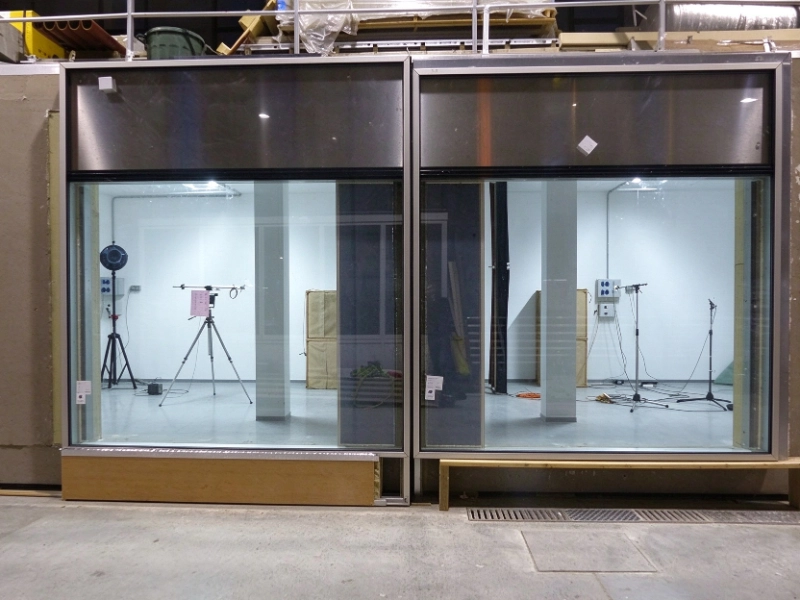
Several questions are worth asking:
A supplier should be able to explain the relationship between panel construction, structural performance, and the available acoustic test evidence.
This is more useful than choosing a panel simply because it has a honeycomb core or a low nominal weight.
Lightweight facade design requires coordination between material properties, panel configurations, structural support, and the environmental requirements of the complete assembly.
The engineering challenge for modern facades is to achieve structural efficiency without overlooking environmental performance.
Established in 1995
Established in 1995, WILLSTRONG® develops facade materials and systems, including aluminum composite panels, fire-resistant composites, and aluminum honeycomb constructions.
For lightweight facade applications, WILLSTRONG® aluminum honeycomb panels (hyperlink anchor: aluminum honeycomb panels) can be considered within a project-specific assembly that takes account of facing sheets, core configuration, support spacing, connections, and installation conditions.
WILLSTRONG's project experience also includes Inner Mongolia Hailar Airport , where architectural art aluminum was applied to curved and hyperbolic facade forms. Projects involving complex geometries highlight an important facade engineering consideration: material weight, panel configuration, supporting structures, and installation requirements must be evaluated together. While lightweight construction can help manage structural loads, its acoustic performance still needs to be assessed through the complete facade assembly rather than material weight alone.
Where sound insulation is a project requirement, the proposed panel should be assessed through relevant frequency-dependent test data and coordinated with the complete facade design. Structural efficiency, fire performance, weather resistance, and acoustic behavior need to be addressed together rather than treated as separate product claims.
The final performance of a facade depends on how its material, panel structure, acoustic properties, and supporting system work together.
The mass law explains why heavier barriers generally provide better airborne sound insulation. But modern facade engineering cannot rely on mass alone.
Aluminum honeycomb construction offers an effective way to achieve bending stiffness with relatively low weight. Its acoustic performance, however, depends on facing sheet mass, panel resonance, coincidence effects, damping, cavity design, and the connections within the complete facade assembly.
The important engineering shift is to stop treating lightweight construction and sound insulation as opposing material choices. They are design requirements that must be coordinated through the panel structure and the wider facade system.